What Is a Roman Nose? Traits and How to Tell
You caught your profile in a shop window or a friend’s video, and the bridge of your nose curved out more than you expected. That curve has a name. Here’s what a Roman nose is, how to tell if you have one and what you can do about it.
Written by Mia Hartley7 min readUpdated
Websites don’t agree on what to call this shape. The same nose can be Roman on one page and aquiline or hooked on the next, and some pages treat it as a problem to fix.
It isn’t a problem. It’s a nose shape, like a straight nose or a button nose, and one photo of your profile is enough to check for it.
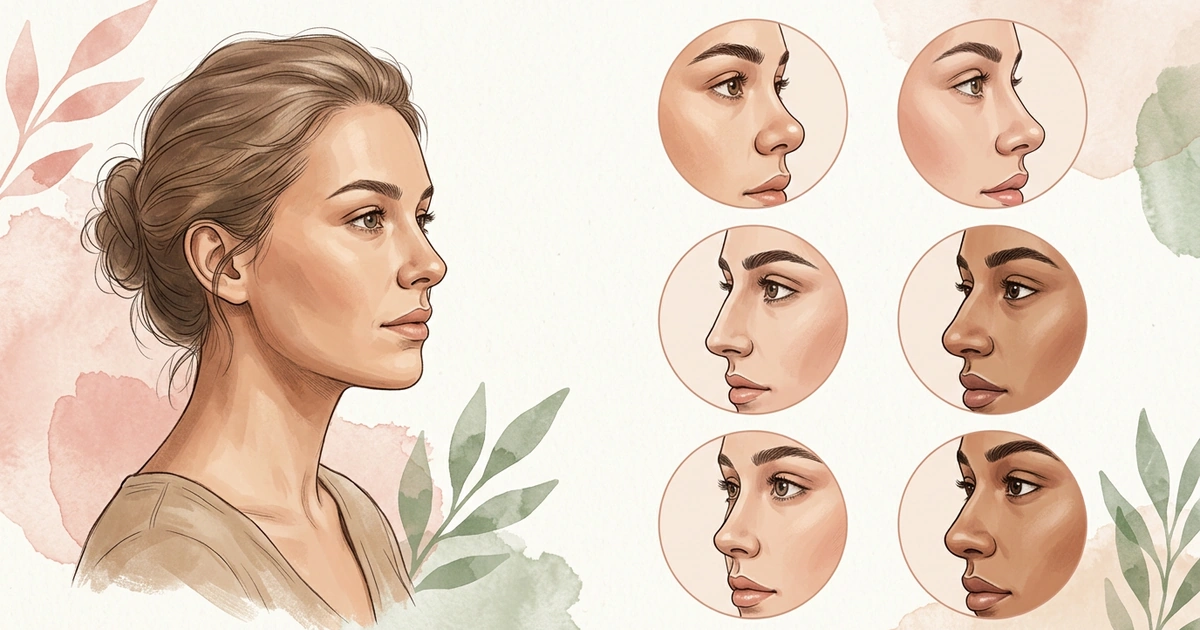
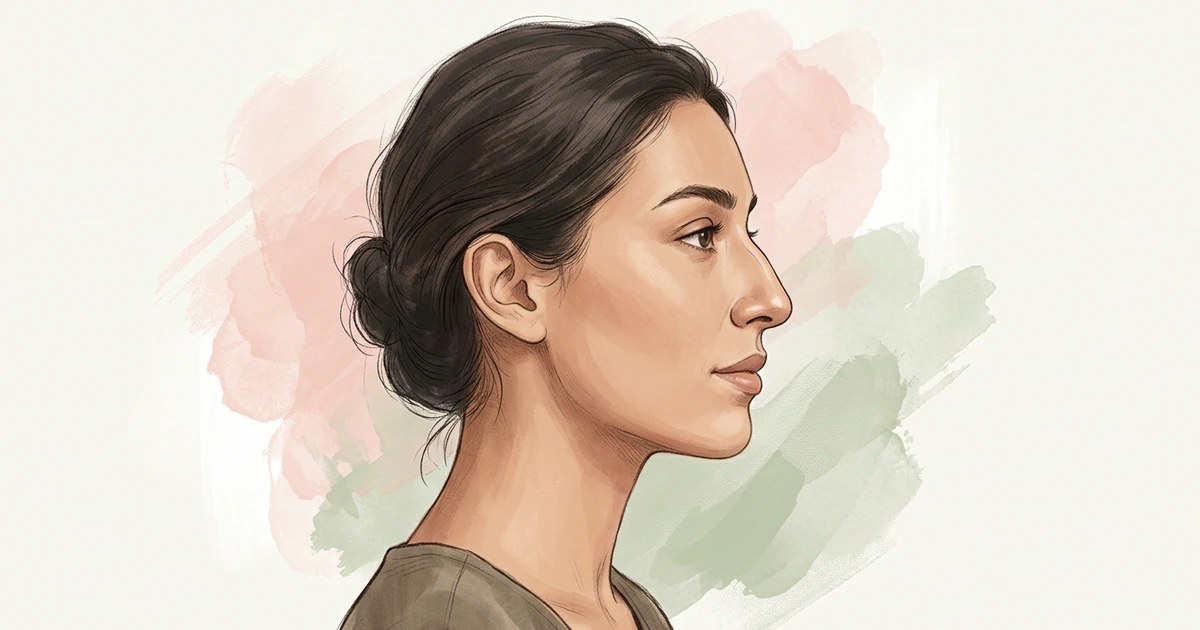
A Roman nose is a nose whose bridge curves outward when seen from the side, with or without a clear bump, while the tip points ahead or tilts a little down. You can’t see it well from the front. Hold a straight edge along your bridge on a photo of your profile. Any gap between the two means you have a Roman nose.
What Does a Roman Nose Look Like?
From the side, the bridge of a Roman nose curves outward. The bridge is the firm ridge that runs down from between your eyes. The curve is usually highest around its upper or middle part, and the tip points straight ahead or dips a little.
From the front, the same nose often looks straight. That’s why a mirror rarely shows it.
The curve can be a long, smooth arc or a short bump. Both count, even when the curve is slight.
The dip between your eyes matters too. A deep dip makes the bridge below it look like a bump. The same bridge running straight up into the forehead doesn’t look bumped at all. So two similar noses can get different names.
How to Tell if You Have a Roman Nose
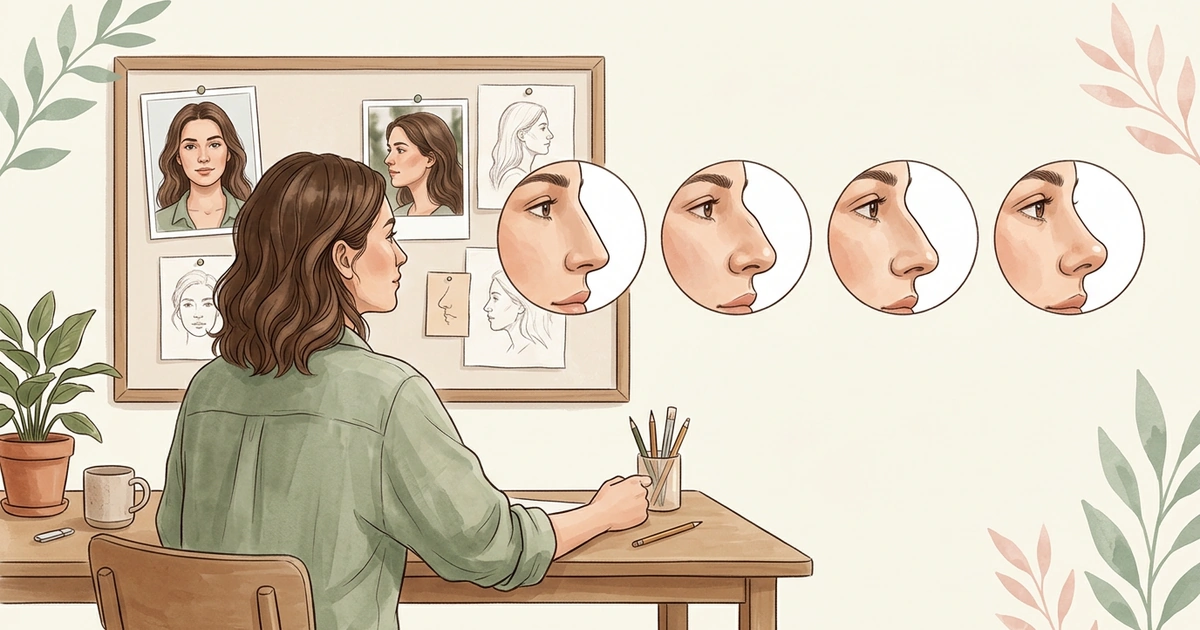
You need a true side photo, not one with your face half turned to the camera, because the curve flattens out as you turn. Take it from about 5 feet away with your chin level, as How to Choose a Photo shows.
Lay a straight edge on the bridge.
Hold a card’s edge or a ruler on your phone screen, from the dip where your nose meets your forehead down to the tip. Any gap between the edge and the bridge means a Roman bridge. No gap from top to bottom means a straight one.
Find the highest point.
Note where the gap under the edge is widest. That’s the high point of your curve. Remember it if you later try makeup or a simulation.
Follow the tip.
Compare where the tip points with your upper lip. Straight ahead or a slight tilt down fits a Roman nose. If the bridge curves strongly and the tip clearly hooks down toward the lip, most charts call it a hawk nose instead.
If your bridge came out straight, What Nose Shape Do I Have? helps you find the name that fits.
Roman vs Aquiline Nose: Is There a Difference?
Mostly no. Most guides use aquiline as another name for a Roman nose. Some say the difference is the tip: Roman while it points ahead, aquiline once it starts to turn down.
None of these names has a fixed definition, so none of them is wrong. If you need to explain your nose to someone, name the parts instead. “My bridge curves out and my tip points ahead” is clear to everyone.
A Greek nose is the opposite: a straight bridge with no curve. Types of Nose Shapes shows how to tell these look-alikes apart.
What Causes a Roman Nose?
Mostly your genes. A large study of twins found that genes explain more than 70% of the differences in nose width, height and how far the nose sticks out. If a parent or grandparent has the same curve, that’s likely where yours comes from.
A bump that appeared after a knock to the nose is different. That’s an injury, not a nose shape. Show it to a doctor, especially if your nose now leans to one side or breathing through it feels harder than before.
Can You Change a Roman Nose?
Yes, in four ways, from a few seconds in front of the camera to a permanent change. Plenty of people keep theirs.
Change the photo. A phone held low looks up along the bridge and makes the curve look bigger. Raise the camera to eye level and turn your face slightly toward it, and the bump softens. More camera tips are in How to Make Your Nose Look Smaller in Pictures.
Use makeup. Brush a matte bronzer, one or two shades darker than your skin, down both sides of the bridge. Put a little highlighter just above and below the bump, but not on it. Shine on the bump draws the eye straight to it.
Try filler. Filler is injected under the skin to add volume. Placed around the bump, it makes the side view look smoother. Nothing is removed, so the nose doesn’t get smaller, and the results usually last 6 to 12 months.
Consider a nose job. Surgery, called rhinoplasty, can lower the bump for good. Surgeons wait until the face is fully grown, usually at 16 or older.
Which of these would work for your nose is something only a surgeon can judge. If you’re thinking about surgery, start with the questions in Should I Get a Nose Job?
How NoseChic Helps You Picture a Straighter Bridge
The high point you found under the straight edge is where a simulation shows its change most clearly. In NoseChic, pick Greek, which explores a straighter bridge, and use the same side photo. Check the style’s photo examples, good and bad, so your angle matches theirs before you add it. The simulation is ready in seconds. Then the Before and After slider moves you between your curve and a straighter line.
If the bump bothers you less than the stretch just above the tip, make a Celestial simulation from that photo too. Celestial gives the bridge a gentle scoop and a tip that turns up, so watch that lower stretch as you compare. Seeing both tells you which part of the curve you really notice.
Greek and Celestial draw a style onto your picture. Neither shows a surgical result or how far your nose could actually change. Save the version you’d pick today and set it beside your straight-edge photo. Together they show how much of the curve you’d want to change, if any.
Frequently Asked Questions
Is a Roman nose the same as a dorsal hump?
Not exactly. A dorsal hump is the bump itself, a raised spot on the bridge of the nose. A Roman nose is the whole side view: the bridge bends outward from top to tip, with the tip pointing ahead or tilting a little down. Many Roman noses have a hump, but a smooth curve with no clear bump is Roman too. A small hump on an otherwise straight bridge is just a hump.
Does a Roman nose affect breathing?
Not by itself. The curve is on the outside of the nose, and breathing depends on the inside. If you struggle to breathe through your nose, an ear, nose and throat (ENT) doctor can check for a cause inside. A common one is a deviated septum, which means the wall between your nostrils leans to one side. That’s separate from the shape.
Is a Roman nose attractive?
There’s no ranking of nose shapes that holds up, so there’s no fixed answer. Plenty of people like a curved bridge, and plenty would rather soften theirs. How it looks on you depends on the face around it, especially your chin and forehead, so your own side photos tell you more than any opinion online.
Sources and further reading
- Rhinoplasty (StatPearls, NCBI Bookshelf)
- Genetic and Environmental Contributions to Facial Morphological Variation: A 3D Population-Based Twin Study (PLOS ONE)
- Nasal Cosmetic Surgery (American Academy of Facial Plastic and Reconstructive Surgery (AAFPRS))
See your new nose in seconds
Download NoseChic, try nose job simulation on your own photo, and find the nose that feels right.